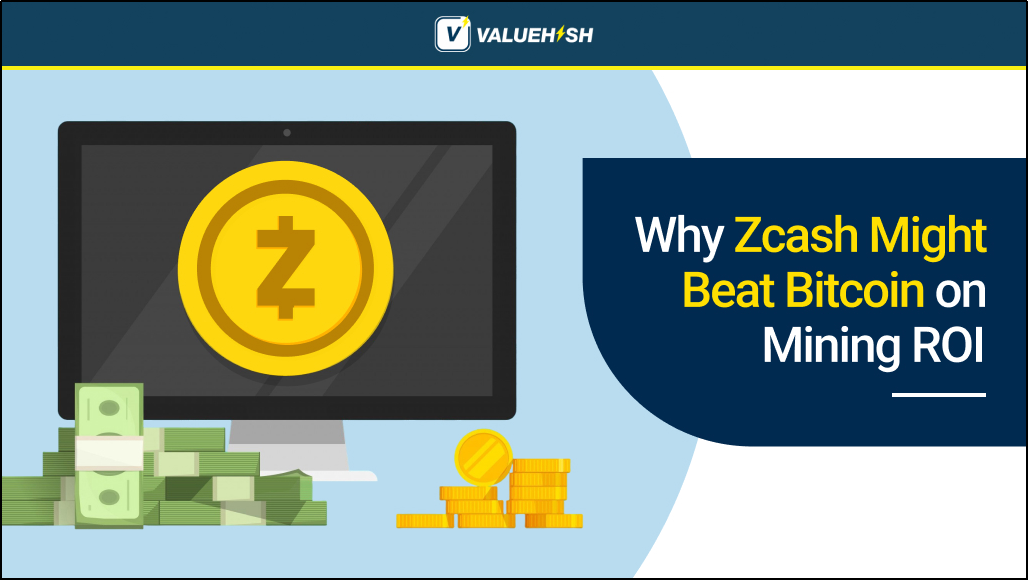
As of early September 2026, Bitcoin is trading in the high-$70,000s down roughly 28% from a year earlier while network difficulty sits near record highs, squeezing margins on all but the newest, most efficient SHA-256 ASICs. Zcash, by contrast, surged about 82% in August 2026 alone on renewed interest in privacy-focused coins, pushing daily revenue per Equihash ASIC sharply higher relative to its power draw.
The result is a rare stretch where a well-run Zcash miner can out-earn a comparable Bitcoin miner on a dollar-per-watt basis though this gap is driven by a price rally, not a permanent structural advantage, so it’s worth understanding both the opportunity and the risk before reallocating hashpower.
Bitcoin Mining Margins Are Getting Squeezed in 2026
Bitcoin mining profitability is a function of three moving parts: coin price, network difficulty, and hardware efficiency (measured in joules per terahash, or J/TH). All three have moved against smaller and mid-size miners this year.
Since the April 2024 halving cut the block reward to 3.125 BTC, miner revenue per block has been structurally lower than in previous cycles. Layer on a Bitcoin price that has pulled back to the high-$70,000s down from roughly $109,000 a year ago and a network hashrate that keeps setting new highs, and hashprice (daily mining revenue per unit of hashrate) has compressed accordingly.
Current-generation air-cooled ASICs like the Antminer S21 XP (13.5 J/TH) generally need an all-in electricity rate under roughly $0.088–0.09/kWh to stay solidly profitable, while older S19-class machines need power closer to $0.055/kWh or lower. Miners paying anything close to residential electricity rates are, in many cases, mining at a loss.
That’s not a claim that Bitcoin mining is broken large-scale operators with sub-$0.05/kWh power purchase agreements and the newest hydro-cooled ASICs are still running healthy margins. But the entry point for smaller and mid-size miners has gotten noticeably narrower.
Why Zcash Mining Economics Look Stronger Right Now
Zcash runs on the Equihash algorithm rather than SHA-256, which means it’s mined with a separate class of ASIC hardware most notably Bitmain’s Antminer Z15 and Z15 Pro. Two forces have combined to make Equihash mining unusually attractive in 2026:
- A sharp price rally. ZEC climbed roughly 82% in August 2026, moving from around $472 to a peak near $890 towards the month end, and was still trading in the $780–$835 range in early September. The rally has been tied to renewed institutional and retail interest in privacy coins, growing shielded-transaction volume on the Zcash network, a widely discussed governance vote (NU7), and commentary linking rising AI-driven surveillance concerns to demand for privacy-preserving assets.
- Lower power draw per machine. Even the flagship Antminer Z15 Pro draws around 2,780W roughly a third less than a top-tier Bitcoin S21-class ASIC pulling 3,500–3,900W. That means less exposure to electricity cost per unit mined, and lower infrastructure requirements to get a machine online.
Network hashrate on Zcash has also been climbing, up an estimated 15% or so over a recent 30-day stretch, as more miners notice the opportunity. That’s the normal self-correcting mechanism of any proof-of-work network: rising price attracts more hashpower, which raises difficulty and gradually erodes the edge. The window doesn’t stay wide open forever, but as of this writing, it’s still meaningfully favorable.
Zcash Miner vs. Bitcoin Miner: ROI Snapshot at $0.10/kWh
The numbers below illustrate the gap using publicly available profitability data at a standard $0.10/kWh electricity rate. They’re a snapshot, not a guarantee both networks’ difficulty and coin prices move constantly.
| Metric | Antminer Z15 Pro (ZEC) | Antminer S21 XP (BTC) |
| Algorithm | Equihash | SHA-256 |
| Hashrate | 840 KSol/s | 270 TH/s |
| Power draw | ~2,780W | ~3,645W |
| Est. daily revenue | ~$38.75 | ~$7.83 |
| Est. daily power cost ($0.10/kWh) | ~$6.67 | ~$8.75 |
| Est. daily net profit | ~$32.07 | Roughly break-even to negative |
The takeaway isn’t that Bitcoin mining is inherently worse it’s that at this specific point in the market cycle, a Zcash miner is earning considerably more per watt than a comparable Bitcoin miner at the same electricity rate. That gap narrows or reverses if ZEC price cools off or Equihash difficulty keeps climbing at its current pace, so these figures should be treated as a current snapshot rather than a long-term forecast.
Lower Barrier to Entry: Cost and Power Requirements Compared
Beyond raw ROI, Equihash hardware tends to be more approachable for miners who aren’t running an industrial-scale facility. A Zcash miner for sale typically costs somewhere in the $3,500–$9,000 range depending on hashrate tier, comparable to or lower than current-generation Bitcoin ASICs, but with meaningfully lower power and cooling requirements. That makes it easier to deploy a small handful of units or scale into a larger deployment without the same electrical infrastructure demands that top-tier Bitcoin mining now requires.
Why Zcash Miner Hosting Makes This ROI Gap Easier to Capture
Because Zcash ASICs still draw well over 1,000W each, and the Z15 Pro in particular benefits from stable, low-cost, always-on power, most serious miners choose professional hosting over running units at home. A hosting facility provides the electrical capacity, ventilation, and 24/7 monitoring needed to keep uptime high which matters even more when a coin’s price is moving quickly and every hour of downtime has an outsized opportunity cost. Providers such as ValueHash offer dedicated Zcash miner hosting across U.S. facilities, giving miners a way to capture this window without having to build out their own power and cooling infrastructure from scratch.
Risks and Limitations to Weigh Before Switching
None of this makes Zcash mining a sure thing. A few factors to weigh before reallocating hashpower:
- Price volatility cuts both ways. ZEC’s climb has been fast, and fast rallies in crypto markets often see sharp pullbacks. Mining ROI calculated at today’s price can look very different in a month.
- Rising network difficulty. As more hashpower joins the Zcash network, each miner’s share of block rewards shrinks, even if the coin price holds steady.
- Hardware and power availability. Equihash ASIC supply is smaller than the Bitcoin ASIC market, and lead times or pricing can shift quickly when demand spikes.
- Governance and protocol changes. Zcash’s active development roadmap (including recent votes like NU7) means the network’s economics and infrastructure can evolve faster than a more mature chain like Bitcoin.
Bitcoin or Zcash: Which Should You Mine Right Now?
For miners with access to very cheap, reliable power and modern hydro-cooled Bitcoin ASICs, mining BTC still makes sense; it remains the largest, most liquid, and most battle-tested proof-of-work network. But for miners evaluating where a marginal dollar of hashpower earns the best return right now, the math currently favors Equihash. A well-placed Zcash miner draws less power, costs less to deploy, and at today’s ZEC price, produces a considerably higher margin than a comparable Bitcoin setup.
Frequently Asked Questions
Is Zcash more profitable to mine than Bitcoin right now?
Based on current data, a Zcash miner like the Antminer Z15 Pro is generating a notably higher profit margin per watt than a comparable Bitcoin ASIC, largely because ZEC’s price has risen sharply while Bitcoin’s price and mining difficulty have compressed margins across the board. This can change quickly as both markets move.
Why has Zcash’s price risen so much in 2026?
ZEC gained roughly 82% in August 2026 alone, driven by renewed demand for privacy-focused cryptocurrencies, growing shielded-transaction activity on the network, a major governance vote, and broader market commentary connecting AI-related privacy concerns to demand for privacy coins.
What hardware do I need to mine Zcash?
Zcash uses the Equihash algorithm, which requires dedicated ASIC hardware such as the Bitmain Antminer Z15 or Z15 Pro the same machines used to mine other Equihash coins like Horizen (ZEN). GPUs are not competitive for Zcash mining today.
Do I need to host my Zcash miner professionally?
It’s not required, but Equihash ASICs still draw well over 1,000W, and consistent, low-cost power is one of the biggest drivers of ROI. Zcash miner hosting through a dedicated facility typically offers better uptime, cooling, and electricity rates than a home setup can match.
Could Bitcoin mining ROI recover?
Yes. Bitcoin mining profitability moves with price, difficulty, and hardware efficiency. A BTC price recovery, a slowdown in network hashrate growth, or the arrival of more efficient ASICs could all shift the balance back in Bitcoin’s favor.
Is this ROI gap permanent?
No, it reflects current market conditions as of early September 2026. Zcash’s rising difficulty and any pullback in ZEC price would narrow the gap, just as a Bitcoin price recovery or falling network difficulty would improve BTC mining margins. Always check live price, difficulty, and hash price data before making a mining decision.
About the Author