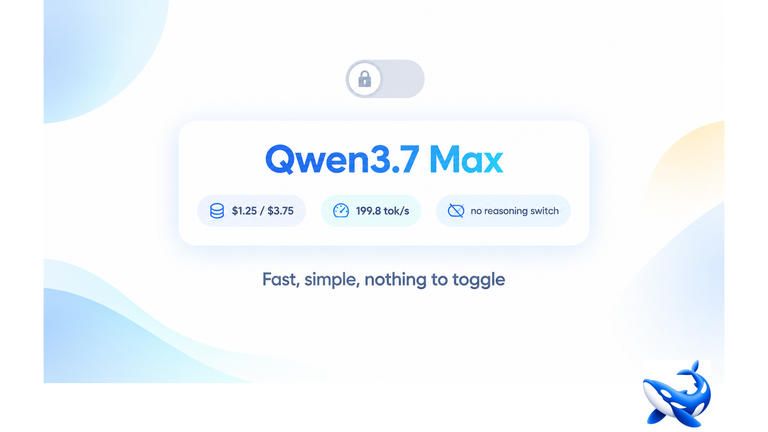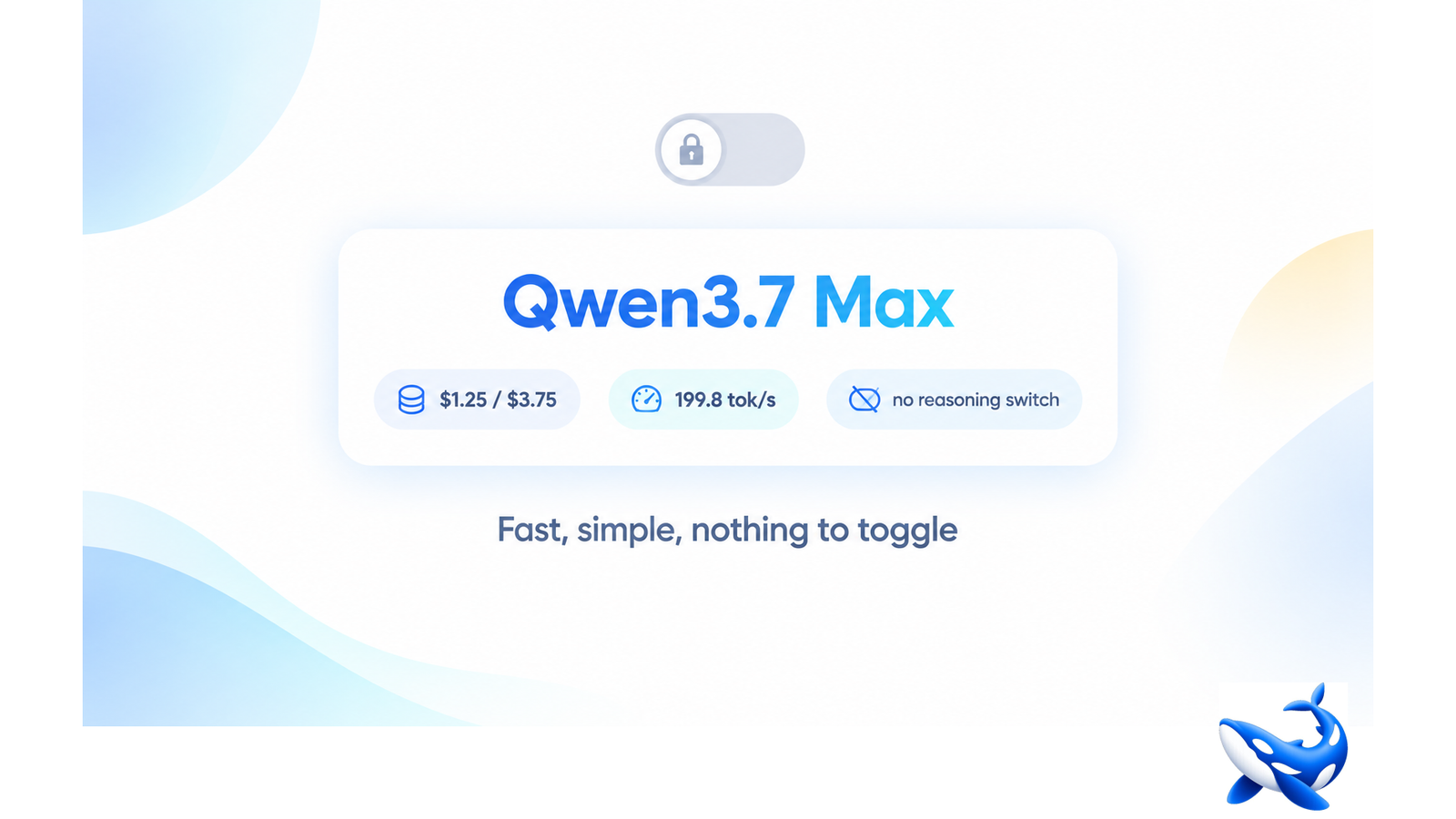
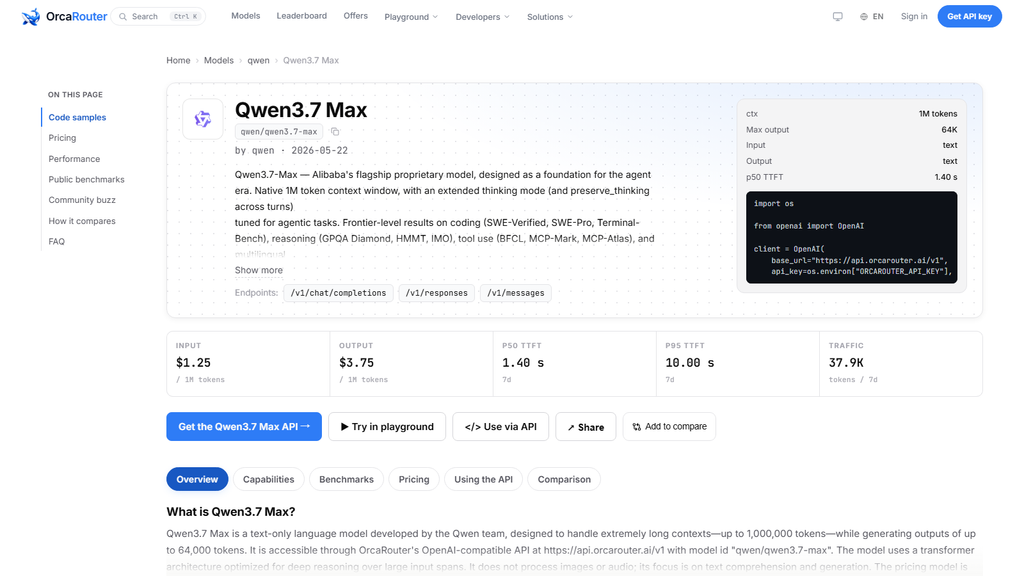
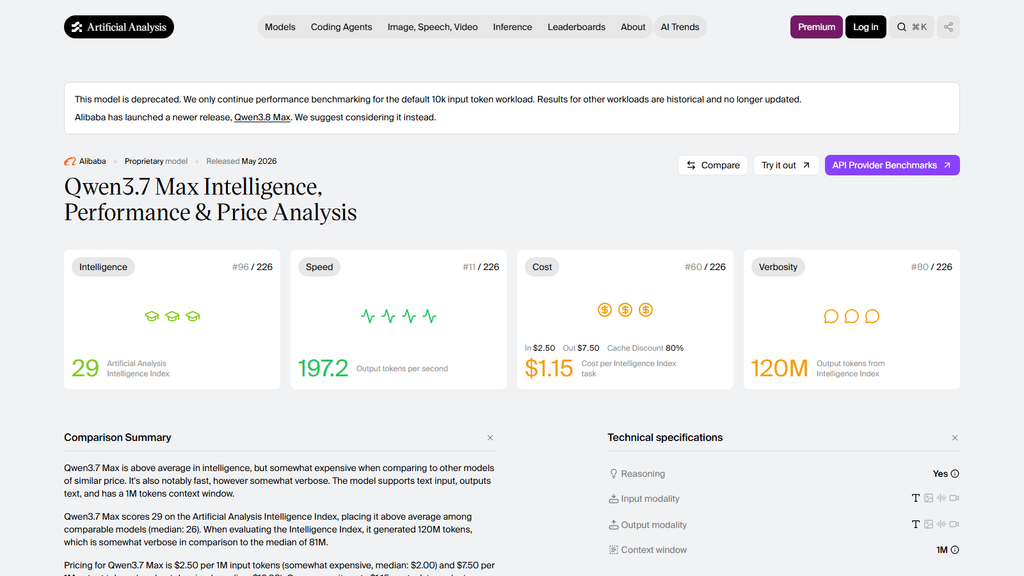
On OrcaRouter we host the Qwen3.7 Max model — the premium rung of Qwen’s previous-generation family, shipped on May 22, 2026, priced at $1.25 per million input tokens and $3.75 per million output, with a 1M-token context window and a 64K maximum output. Artificial Analysis scores it 29 with an output speed of 199.8 tokens per second and a per-task cost of $1.15. In production its p50 time-to-first-token is 1.27 seconds — among the fastest first tokens of any card in this fleet. It is carried at list price on the same key as every other Qwen model, with the live telemetry on the linked page.
A premium card that answers its first token in 1.27 seconds and offers no reasoning switch to toggle is a card whose whole argument is speed and simplicity — and this article is about why that argument wins.
A premium card that just answers
The production record is the headline: a p50 first token of 1.27 seconds, faster than the current generation’s Max card at 3.12 and faster than most of the mid rungs in this fleet. That is the premium experience done right — the reader sends a question and the answer starts before a human would finish reading the prompt back. The latency is the card’s first and strongest argument, and it is an argument the independent record supports rather than contradicts: 199.8 tokens per second of output on the board means the speed is not a production-only finding.
The other side of the same card is the simplicity. Qwen3.7 Max’s directory entry carries no reasoning switch — the endpoint does not offer a toggle between reasoning and non-reasoning modes, and this article reports exactly that: there is no reasoning switch to misread. The card is what it is, every time, which is a feature for the teams that have been burned by a switch left in the wrong position.
The previous generation at speed
| model | context | input / output | AA index | output speed | per-task cost | p50 TTFT |
| Qwen3.7 Max | 1M | $1.25 / $3.75 | 29 | 199.8 tok/s | $1.15 | 1.27 s |
| Qwen3.7 Plus | 1M | $0.35 / $1.42 | 25 | 54.2 tok/s | $0.22 | 2.98 s |
| Qwen3.8 Max (0902) | 1M (AA: 984K) | $2 / $6 | 45 | 37.0 tok/s | $5.41 | 3.12 s |
Context windows and rate cards are what Qwen lists; the index scores, output speeds and per-task costs are Artificial Analysis’ live readings; the TTFT column is production telemetry from the linked pages. The table makes the two Max generations legible as a genuine trade: the 0902 card scores sixteen points higher but costs five times more per task and answers its first token two-and-a-half times slower, while Qwen3.7 Max holds the speed crown at a fraction of the cost. That is the whole shape of the buy: the old Max is the fast, simple, cheaper premium; the new Max is the ceiling.
The no-switch advantage
A reasoning switch is one of the most quietly expensive features in a model’s directory entry: the two modes behave differently, the wrong mode costs the user money or quality, and a team’s prompts written for one mode silently underperform in the other. Qwen3.7 Max’s directory entry sidesteps the whole class of bug — there is no reasoning switch, and no tool switching to configure either. The endpoint is one behavior, priced once, and this article reports the absence plainly rather than dressing it up.
The honesty rule applies in both directions. The absence is not a quality claim; this article will not argue that no switch means better answers, only that it means fewer knobs. The 29 index reading is the board’s own answer on quality — a competent premium card, not the family’s ceiling. What the no-switch design buys is predictability: the same prompt, the same behavior, the same $1.15 per task, every run.
The workload that fits a fast premium
The shape of the buy follows the numbers. A premium card at $1.25 / $3.75 with a 1.27-second first token is for interactive work where the ceiling is good enough and speed is the product — customer-facing agents, latency-sensitive pipelines, anything where a human or a request queue is waiting. The 199.8 tokens per second output keeps long generations fast too, which is the second half of the interactive story. For that workload, Qwen3.7 Max is not a legacy holdover; it is the fast rung of the family.
The honest boundary is the ceiling. Where the workload needs what the 0902 card’s 45 scores, or where a reasoning mode would genuinely help, the previous-generation Max is the wrong tool and the family’s ladder has the rung for it. The production record on the linked page shows where the market has settled: 37.5K tokens in seven days is a whisper of volume, the smallest in this table — the old Max is a specialist, not a fleet mover, and this article’s advice is to buy it exactly that way.
The 1.27-second figure is worth dwelling on, because it is the one number a premium card cannot fake. Output speed and index scores are measured on workloads the buyer does not run; first-token latency is the raw feel of the product — the human sends the prompt, and the card either makes them wait or it does not. At 1.27 seconds the waiting is over before it registers as waiting, which is why the interactive workloads cluster here: an agent loop that turns twenty times an hour at 1.27 seconds each spends a quarter of the time just waiting for its first tokens that a three-second card would spend, and across a shift that difference is the difference between a snappy assistant and a sluggish one. The cheap rungs of the family answer in three to four seconds and are perfectly adequate for batch work; the premium card earns its $1.25 / $3.75 on the jobs where that first-second gap is the product. That is the honest division of labor between the rungs, and it is the reason a previous-generation card still earns a seat in the fleet.
The takeaway
Qwen3.7 Max is the premium rung of Qwen’s previous generation: $1.25 / $3.75, a 1M context window, a 64K maximum output, and a p50 first token of 1.27 seconds on our production record — among the fastest in this fleet. Artificial Analysis scores it 29 at 199.8 tokens per second and $1.15 per task. Its directory entry carries no reasoning switch, and this article reports it plainly: no switch to misread, one behavior, priced once. It is a fast, simple, cheaper premium than the current Max generation — the specialist for interactive work, live at list price, with the telemetry on the linked page.
Sourcing note: release date, context window and rate card are what Qwen lists and have not been independently reproduced. The Intelligence Index score, output speed and per-task cost are from Artificial Analysis’ live model page, read 2026-10-08. The p50 time-to-first-token and seven-day token volume are OrcaRouter production telemetry from the linked model page. The absence of a reasoning switch and tool switches is per the model’s directory entry as of 2026-10-08. All checked 2026-10-08.
About the Author